
Did TikTok kill social media?
Wher the social media go?
Back in 1992, music magazine Mixmag broke the article “Did Charly kill rave?”. A year before, the future cult band The Prodigy released their first super-successful track “Charly”, which was the subject of the article. The authors argued that the band’s work had made underground music pop and thereby led to the death of the genre. They were wrong, of course 🙂 Rave, just like electronic music in general, has only become more successful and popular, spawning many more big names.
But what have The Prodigy and Mixmag got to do with the channel topic? I was reminded of this article exactly when I read the latest news about the changes and then rollbacks of Instagram updates and what preceded them. This news was just in the channel’s latest selection. As I recall, many users of the service (including celebrities of varying magnitude) were outraged that Instagram with the latest updates was turning into a feed of videos and starting to look more and more like TikTok. But I’ll venture to disagree that this is just a botched product update. Let’s reflect on what underlies such a change.
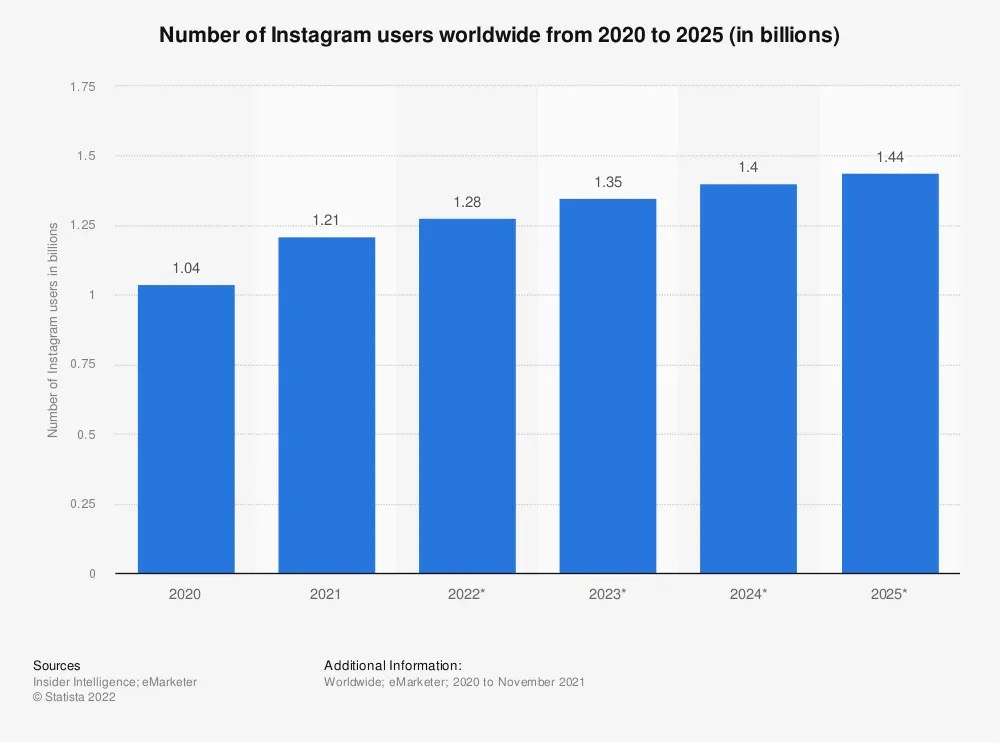
Over the last few years, Meta’s two main products (OK, Instagram was bought, but still) have become absolute monopolists in the social media niche. Sure, many specialized services also have huge audiences, like Linkedin, but globally, if we’re talking about social products for anyone and everyone, they essentially have no competitors outside of niche solutions. Facebook, as of April 2022, has almost 3 billion (!) monthly active users, plus Instagram’s 1.2 billion MAU respectively. And that’s not even the total user base, obviously, there are quite a few more occasional visitors. Those are incredible numbers and it would seem, why would they copy anyone at all? The thing is, despite the impressive absolute numbers, their growth relative to previous periods no longer looks so colorful. Before 2021 Instagram was growing by about 20% YoY, while in 2022 its growth rate is forecasted to be only about 6% (there’s no point in looking further because most of the forecasts there are taken out of thin air).
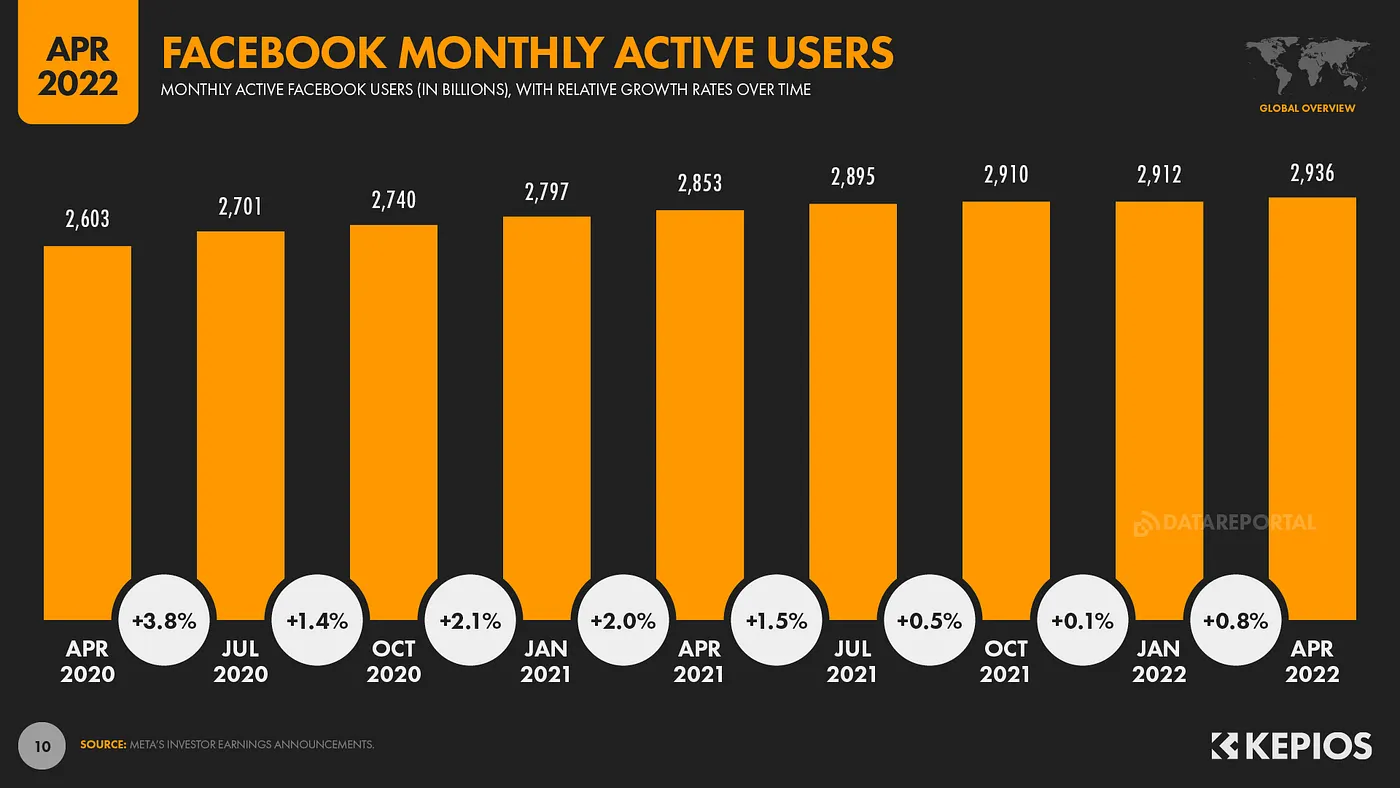
Facebook’s situation is even worse. From 2021 onwards, growth slows catastrophically, falling to 0.1–0.5% YoY.
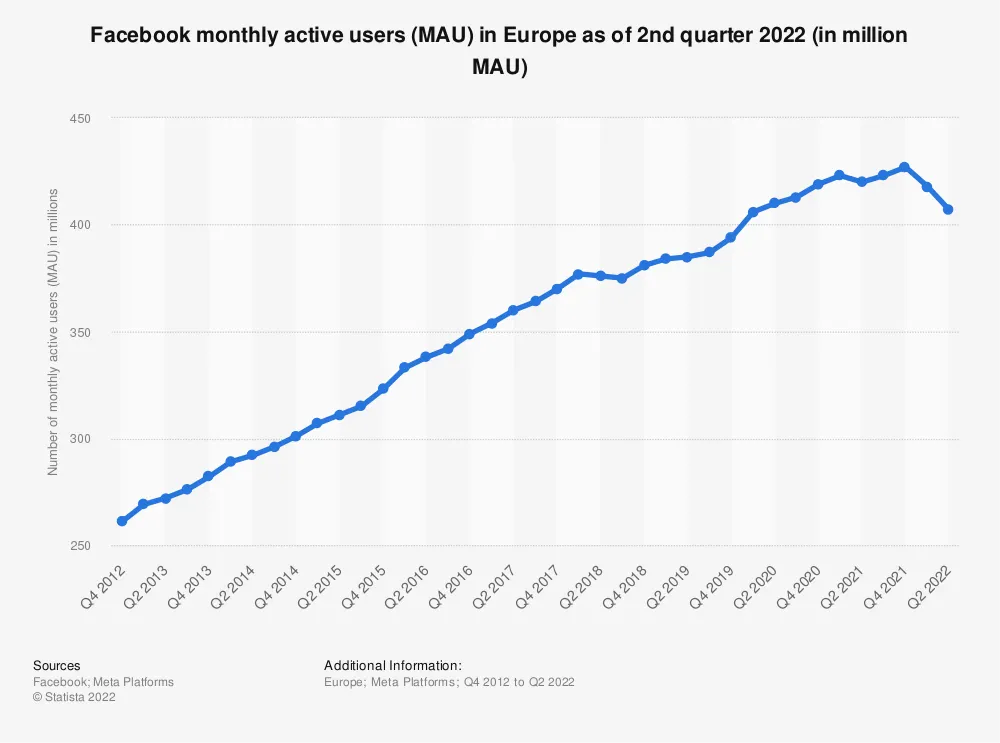
And in Europe, there is a user churn and a decline in MAU altogether.
Even worse for Zuckerberg, thanks to the efforts of Apple to supposedly take care of our privacy, advertising revenue, the mainstay of the Meta ecosystem so far, is taking a very painful blow and the Ad Reach metrics are going through a tailspin. A separate article could be written about Cook’s redistribution of the advertising market under the pretext of protecting user data (which of course is a lie), but that’s not so important now, what is important is that Meta is feeling a little bad at the distance and in the forecasts.
Why is this happening? There are probably several reasons, but let’s remember what the growth and virality of such products in general are based on. First and foremost, of course, is social connections: you make a connection with someone, you make or find common acquaintances — you make another connection, forming your own little network, which in turn intersects with other networks and merges into an even larger network of social contacts, and so on. This works fine as long as you don’t get too big. In the 1990s, British anthropologist Robin Dunbar did a study of social group bonding (read a brief account of it here, for example). According to him, he worked out what he called Dunbar’s “number” — 150, which is how many meaningful social connections our brains can naturally maintain. He further developed this theory into “Danber’s layers”, where it is assumed that our social connections can be broken down into groups (layers), each with its own limits and quality of connections.

While more recent Stockholm University research from 2021 has deconstructed this research and Danber’s number itself (it finds that variation in social group size is greater than expected, and the 95% confidence interval is between 2 and 520), the conclusion that natural size is finite and the strength (quality) of connections decreases much fold after the limit is reached is the same.
What does this give us? At a certain point, when your product becomes dominant in the marketplace, growing it through more social connections becomes extremely problematic. The user doesn’t actively connect with more people, doesn’t attract more users to the product, and becomes uninterested in following the status updates of people they don’t know — which, it should be noted, was what the Facebook feed was originally built on. But if we can’t grow the product through connections, what can we grow it through? By consuming content — we have no limits in our brains for that, we can consume pictures, funny videos, and the like from an infinite number of other people, regardless of whether we know them personally or first saw the account.
In fact, experimentation in this direction started long before TikTok came along. Just remember how the Fb feed was changing: more and more focus on entertaining content, more and more recommendations not from your contacts. But Meta are not fools, they couldn’t help noticing such a phenomenon as TikTok, which succeeded in this matter better than anyone else, and their explosive growth proves it. Well, if they’re good at it, why not work in that direction? Has the format of consumed content changed from long reads to short videos (easier and faster)? Ok, let’s promote this format on Instagram and Fb. People are gushing over unfamiliar users’ videos? Great, let’s saturate the feed with recommended endless content to the detriment of friends’ posts.
I’m more than confident that Zuckerberg isn’t lying when he says that experiments show the success of these updates. Such endless feeds go a long way towards increasing engagement and the time users spend on services. And if you can’t grow MAU like before, grow time spent. It’s simple 😅 Another issue is that Power Users and the loyal base may not accept the updates, as it happened, and you need to be careful with them. But that’s what experimentation is for.
So is TikTok killing social media? We can see that Meta is changing the paradigm from connecting to consuming, mimicking a competitor from Asia. But I don’t think this means the death of social media as such. It means the death of social platforms as places to make “meaningful” social connections, such connections are losing relevance. From now on, Facebook, like TikTok, wants to pump you full of endorphin by simply entertaining you and keeping you on the app as long as possible.